
If you’re looking for a natural approach to thinning hair, saw palmetto is worth understanding, not because it’s a guaranteed fix, but because it has a plausible link to one pathway involved in pattern hair loss.
Here’s what the research suggests, where it falls short, and how to judge a supplement label without mistaking a big number for proof.
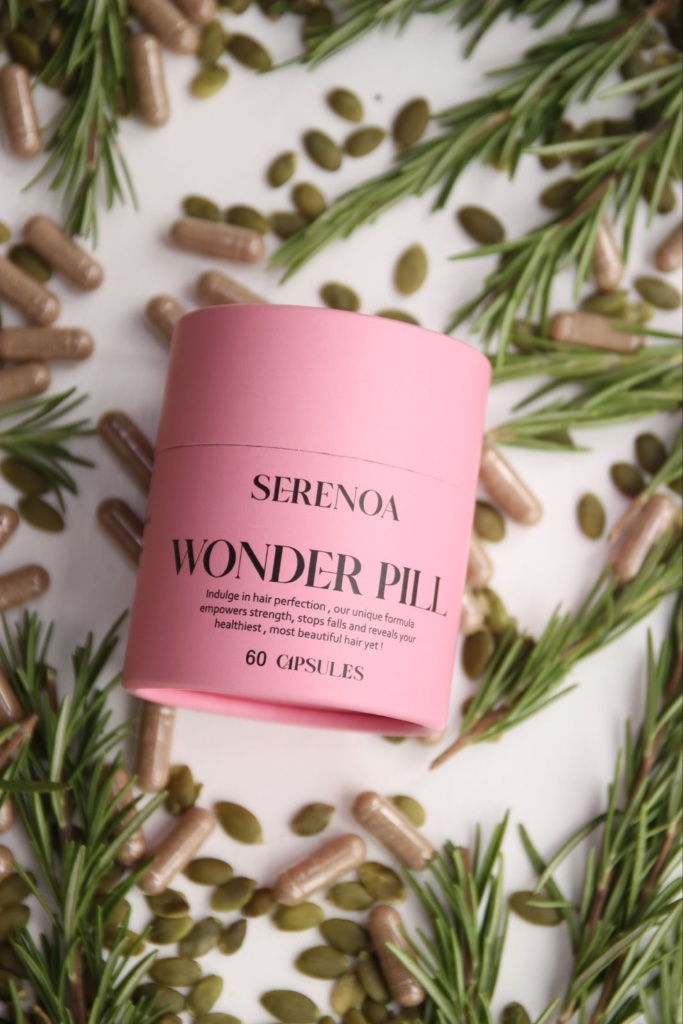
Considering a supplement? Explore Serenoa Health’s Wonder Pill: a three-ingredient formula with 400mg of saw palmetto, 150mg of pumpkin seed and 100mg of rosemary.
What is saw palmetto?
Saw palmetto (Serenoa repens) is a small palm native to the southeastern United States. Its berries are used in supplements, often as an extract or ground plant material.
It’s studied for its possible effects on androgen activity. Androgens are hormones that include testosterone and dihydrotestosterone, or DHT. In people with a genetic sensitivity to DHT, this hormone can contribute to the gradual miniaturisation of hair follicles: a process associated with androgenetic alopecia, also called pattern hair loss.
That connection is the reason saw palmetto appears in many hair loss supplements. But a plausible mechanism is not the same as proven hair regrowth.

How might it affect DHT?
The proposed mechanism centres on an enzyme called 5-alpha-reductase. It converts testosterone into DHT. Laboratory research suggests that compounds in saw palmetto may interfere with this conversion.
In plain terms: saw palmetto is being studied as a possible way to influence DHT production. It is not established as a reliable or predictable DHT blocker supplement in the way that wording might imply. A laboratory effect does not tell us how much a particular product changes DHT in the body, or whether that change will meaningfully affect hair.
A small 2023 study of a specific, standardised saw palmetto oil reported a reduction in serum DHT after oral use. That’s a useful research signal, not proof that every saw palmetto product has the same effect. The study was short, and its formulation cannot be treated as interchangeable with every powder or extract.
What has human research found?
The human evidence is promising in places, but still limited.
A 2020 systematic review examined studies of oral and topical saw-palmetto-containing products for hair loss. Some reported improvements in hair measures. The authors also highlighted important limitations: there were few studies, the products and methods differed, and several formulations combined saw palmetto with other ingredients. That makes it difficult to know how much benefit came from saw palmetto itself.
A 2023 randomised, placebo-controlled study tested one standardised oil in 80 people over 16 weeks. The researchers reported improvements in hair fall and density for some treatment groups. Those results apply to the product and study conditions they tested. They do not establish long-term results, or prove that other forms of saw palmetto will perform the same way.
There’s also a small, two-year comparison in men that reported hair-growth improvement in 38% of those taking saw palmetto, compared with 68% taking finasteride. The study was open-label, so it has limitations, but it helps show why saw palmetto shouldn’t be presented as “natural finasteride.” The evidence for finasteride is stronger.
The honest summary: Saw palmetto may help some people with pattern hair loss. Researchers have not yet established that it reliably regrows hair, works for every cause of shedding, or matches established treatments.
Does the dose tell you whether a supplement is effective?
A label listing 50mg may look underwhelming next to one listing 400mg. But milligrams alone don’t tell the whole story.
Saw palmetto products can use different forms, such as ground berries or concentrated extracts. Their composition and standardisation can differ, too. So 400mg of ground berry is not automatically equivalent to 400mg of an extract used in a clinical trial. Nor does a larger number, on its own, prove better results.
Some supplements provide only a small amount of an ingredient. It’s reasonable to check whether the dose is clearly stated and whether the product explains what form it uses. But there is no single, universally established clinical dose for saw palmetto hair treatment.
At Serenoa Health, Wonder Pill contains 400mg of saw palmetto alongside 150mg of pumpkin seed and 100mg of rosemary. The ingredients are listed clearly, with no binders or fillers. That makes the formula easy to inspect. It does not mean the product has been proven in a clinical trial to produce a particular hair outcome.

Who might consider it?
Saw palmetto may interest adults experiencing gradual, pattern-type thinning who want to explore a plant-based option. That can include men and women, including some people whose hormonal changes are part of the picture.
But hair loss is not one condition. Hormonal hair loss may be associated with androgen sensitivity, while shedding can also relate to stress, illness, nutritional deficiencies, thyroid conditions, medication or other causes. In women, irregular cycles or symptoms associated with PCOS may be reasons to seek medical advice, not reasons to assume saw palmetto is the answer.
If your shedding is sudden, patchy, painful, or accompanied by scalp irritation, arrange an assessment. A clinician or dermatologist can help identify the cause and discuss treatments with stronger evidence where appropriate.
What won’t saw palmetto do?
Saw palmetto is not a guaranteed cure, a substitute for diagnosis, or a proven treatment for every kind of thinning. It cannot promise to reverse long-standing follicle changes. And evidence about one standardised extract should not be used to claim that all supplements work in the same way.
It also shouldn’t be relied on to treat PCOS, regulate menstrual cycles, or correct a hormonal imbalance. Those concerns deserve individual medical care.
If you’re pregnant, trying to become pregnant or breastfeeding, speak to a healthcare professional before using saw palmetto. Because it may affect hormone pathways, check with a clinician or pharmacist if you take medication, have a hormone-sensitive condition, or are preparing for surgery. The US National Center for Complementary and Integrative Health notes that evidence for saw palmetto in male-pattern hair loss remains too limited for a firm conclusion.
Choose transparency over big promises
A useful supplement label should tell you what’s inside and how much. It should not rely on a long ingredient list, vague “proprietary blends” or claims that a natural product is automatically proven.
Wonder Pill keeps the formula straightforward: 400mg saw palmetto, 150mg pumpkin seed and 100mg rosemary. It is vegan and hand-filled in Scotland, with no binders or fillers. Those details make the product easier to understand, not a guarantee of an individual result.
The bottom line
Saw palmetto has a credible biological rationale and early human research worth following. But today’s evidence is small and mixed, and it does not establish saw palmetto as a proven equivalent to prescription treatments.
If you choose to try a natural hair loss treatment, choose a clearly labelled product, set realistic expectations and give a clinician the chance to identify the cause of your hair loss. Simple ingredients and honest claims are a better starting point than miracle promises.
Want to see exactly what’s in the formula? View Wonder Pill or visit our frequently asked questions.